Extracting Data from Oracle Fusion ERP Using Oracle Data Transforms
1. Introduction
Extracting data from Oracle Fusion ERP has traditionally been complex and time‑consuming. While tools such as BI Cloud Connector (BICC), OTBI, BI Publisher, and custom APIs all have valid use cases, they often introduce challenges related to scalability, maintainability, or operational overhead.
Oracle Data Transforms (ODT) provides a modern, cloud‑native alternative. ODT enables teams to visually design, orchestrate, and automate large‑scale Fusion ERP data extractions into Oracle Cloud Infrastructure (OCI) services such as Autonomous Data Warehouse (ADW) and OCI Object Storage—without writing custom code.
2. What Is Oracle Data Transforms (ODT)?
Oracle Data Transforms is a low‑code, serverless data integration service within OCI designed to support ELT‑style pipelines at scale. ODT allows you to:
Build visual data pipelines
Extract and transform Fusion SaaS data
Orchestrate full and incremental loads
Load data into Autonomous Database or Object Storage
Schedule and monitor jobs end‑to‑end
Unlike legacy ETL tools, ODT is fully cloud‑native and tightly integrated with OCI security, networking, and database services.
3. Why Use ODT for Fusion ERP Data Extraction?
ODT fills important gaps left by other approaches:
Compared to BICC Alone
Adds structured transformations
Supports staging and incremental logic
Eliminates custom scripting and VM management
Compared to OTBI / BI Publisher
Designed for bulk data pipelines, not reports
Handles large‑volume, multi‑subject extracts efficiently
Compared to APIs
APIs are optimized for transactional use cases
ODT supports automated full and incremental bulk loads
ODT is ideal for:
Feeding enterprise data warehouses and data lakes
Extracting Financials, SCM, HCM, and PPM data
Building repeatable, auditable ERP data pipelines
4. Architecture Overview
A typical ODT‑based Fusion ERP extraction pipeline follows this pattern:
Oracle Fusion ERP (BICC) → Oracle Data Transforms → OCI Object Storage → Autonomous Data Warehouse
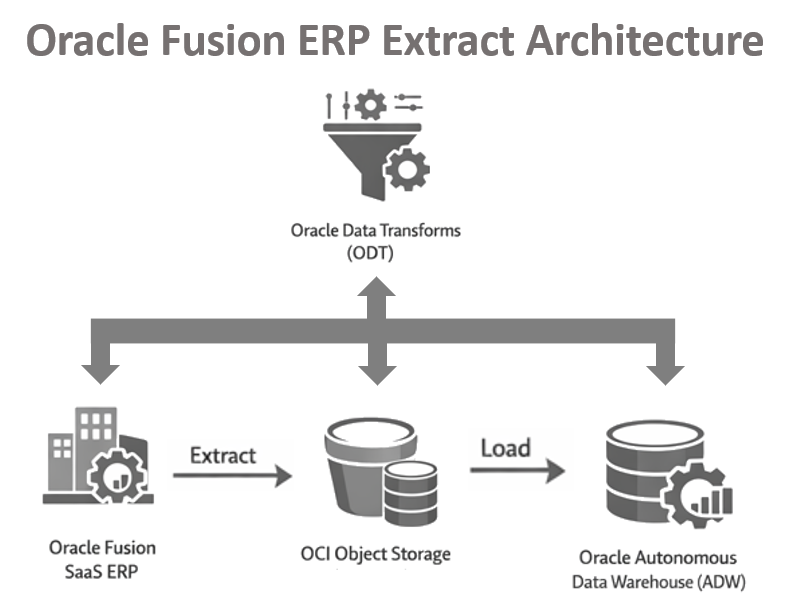
Component Roles
Fusion ERP (BICC)
Securely exposes business objects (View Objects) for extraction.Oracle Data Transforms (ODT)
Orchestrates extraction, transformation, and loading workflows.OCI Object Storage
Serves as staging and archival storage for extracted files.Autonomous Data Warehouse (ADW)
Final analytical destination for reporting, dashboards, and analytics.
This architecture balances security, performance, scalability, and operational simplicity.
5. Prerequisites
Before starting, ensure the following are in place.
Oracle Cloud Infrastructure (OCI)
Active OCI tenancy
Autonomous Data Warehouse instance
OCI Object Storage bucket
Oracle Data Transforms enabled (included with ADW)
Fusion ERP
User with BICC execution privileges
External storage configuration capability
Access Requirements
OCI Console access (administrative)
Fusion ERP BI Cloud Connector access